Targeted Delivery with Lipid Nanoparticles
Precision Medicine through ivcRNA-LNP Systems
Efficient delivery is a critical factor in the success of RNA-based therapies. To ensure that circular RNA reaches the target cells within the joint, researchers developed a targeted delivery system based on lipid nanoparticles (LNPs).
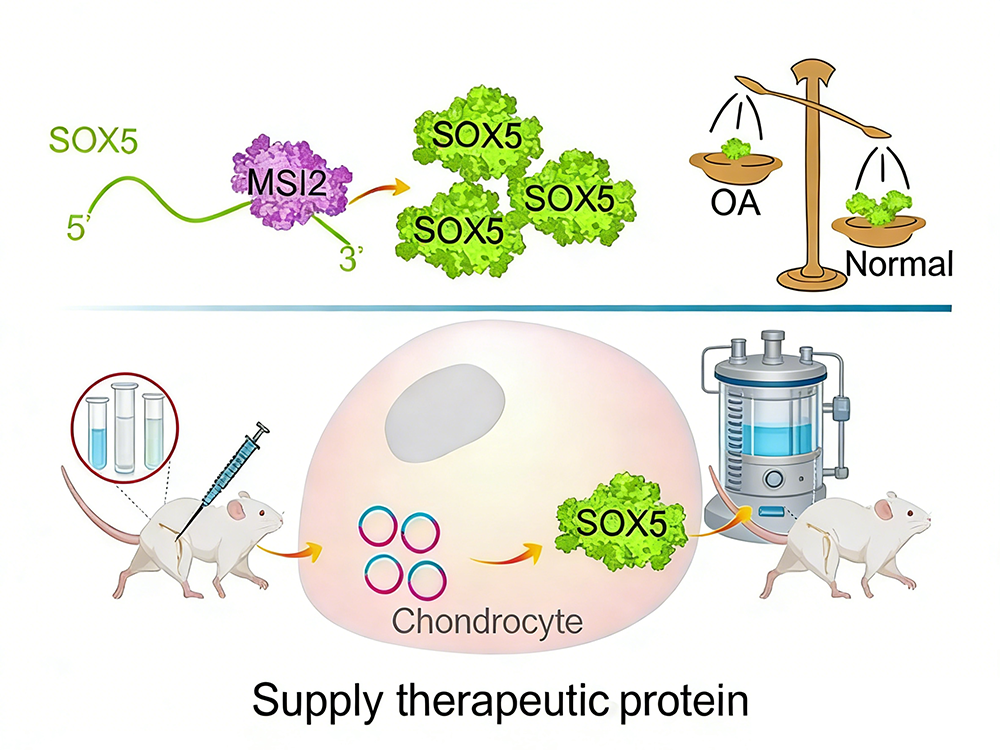
These LNPs are similar to those used in some COVID-19 vaccines and have already been clinically validated for nucleic acid delivery. In this study, ivcRNA encoding the Msi2 protein was encapsulated within lipid nanoparticles, allowing the RNA molecules to be protected and efficiently transported into chondrocytes.
The treatment was administered through direct intra-articular injection, enabling precise targeting of cartilage tissue.
To further enhance translation efficiency, the researchers incorporated a chondrocyte-specific Internal Ribosome Entry Site (IRES). This design ensured that the circular RNA could be effectively translated into functional proteins specifically within cartilage cells.
Experimental results showed that ivcRNA-mediated protein expression lasted more than seven days, significantly longer than the typical three-day expression period observed with linear mRNA.
Importantly, the expression remained stable even within the inflammatory microenvironment of osteoarthritic joints, demonstrating the robustness of the circular RNA platform.
Promising Results in Preclinical Models
Significant Improvement in Osteoarthritis Symptoms
The therapeutic potential of circular RNA was further validated in a mouse model of osteoarthritis, specifically the destabilization of the medial meniscus (DMM) model.
Following injection of ivcRNA encoding the Msi2 protein, researchers observed several encouraging outcomes:
Reduced cartilage calcification
Decreased cartilage erosion and joint damage
Significant reduction in OARSI (Osteoarthritis Research Society International) scores
These results indicate that restoring Msi2 expression can effectively slow or even reverse cartilage degeneration.
The research team also explored additional therapeutic targets within the same signaling pathway. For example, SOX5, a downstream protein regulated by Msi2, was delivered using ivcRNA technology and demonstrated similarly strong therapeutic effects.
This finding highlights the versatility of circular RNA-based therapies, which can be adapted to deliver different therapeutic proteins depending on disease mechanisms.
Safety Profile and Dosage Advantages
One of the most striking findings of the study was the excellent safety profile of the circular RNA therapy.
Compared with traditional mRNA therapeutics, which often require 5–50 μg doses, the ivcRNA treatment achieved strong efficacy at extremely low doses of only 100–300 ng per injection.
Lower dosage requirements bring several advantages:
Reduced risk of adverse immune reactions
Lower manufacturing costs
Improved patient safety
Importantly, no significant inflammatory responses were observed during the experiments, supporting the potential of circular RNA as a safe therapeutic platform.
Implications for Biopharmaceutical Manufacturing
Growing Demand for Advanced Bioprocess Solutions
While circular RNA therapeutics represent a major scientific breakthrough, their successful commercialization will depend heavily on scalable and compliant biomanufacturing technologies.
Large-scale production of ivcRNA requires sophisticated bioprocess modules covering the entire workflow, including:
Microbial & cell culture systems for RNA production platforms
Media & buffer preparation systems to ensure consistent upstream processing
Clarification & harvest technologies for efficient separation of biomolecules
Purification & filtration solutions to remove impurities and ensure RNA purity
Virus safety systems to meet global biopharmaceutical safety standards
Cleaning & waste inactivation systems for GMP-compliant manufacturing environments
Companies specializing in biopharmaceutical equipment and integrated biotech solutions, such as Shanghai Ritai Medicine Equipment Project Co., Ltd., play a crucial role in enabling these emerging therapies.
With expertise in cGMP-compliant process vessel manufacturing, modular bioprocess lines, and integrated valve-piping systems, Ritai provides full-lifecycle support for biopharmaceutical manufacturers—from facility design and equipment installation to validation and operational training.
These customizable biopharmaceutical process solutions help companies accelerate product development, scale up production, and meet stringent global regulatory standards such as FDA, EU GMP, and PED-CE compliance.
From Laboratory Discovery to Clinical Application
The emergence of circular RNA technology marks a pivotal moment in the evolution of RNA therapeutics. By enabling stable and long-lasting protein expression, circRNA platforms have the potential to transform the treatment of chronic degenerative diseases like osteoarthritis.
However, moving from promising laboratory results to real-world therapies requires not only scientific innovation but also robust bioprocess engineering, scalable manufacturing infrastructure, and strict regulatory compliance.
Through advanced biopharmaceutical process solutions, modular manufacturing platforms, and integrated production systems, the biotechnology industry is now better equipped than ever to support the commercialization of next-generation RNA medicines.
As circular RNA therapies continue to advance toward clinical trials and industrial production, they may ultimately deliver the long-awaited disease-modifying treatment for osteoarthritis, improving the quality of life for millions of patients worldwide while opening a new chapter in the biopharmaceutical industry.